Abstract
During the integration of a private enterprise with a state-owned company, cultural clashes and different management philosophies pushed the merged team into low collaboration and fragmented goals. At this painful but critical stage, the company introduced an international team coaching framework and ran a nine‑month systemic coaching journey. From diagnosis to deep intervention, the project activated cohesion and execution and significantly lifted key business metrics: tripled overall sales and sixfold sales revenue, injecting crucial momentum into the wider transformation.
Case Portrait: Enabling Integration Across Cultures, Recreate Collaboration through Team Coaching
The automotive group ranks among the leading players in China’s auto industry, with strong performance in passenger cars, engines, transmissions and components manufacturing. As part of its expansion, it entered the electric commercial vehicle market by acquiring a state‑owned company in Southwest China.
However, gaps between private and state‑owned in cultures, management styles and execution mechanisms caused frequent friction during integration:
- Weak cohesion between teams and low mutual trust
- Work styles differed greatly, cross‑department collaboration faced serious obstacles
- Management philosophies diverged, slowing decision making
- A lack of no shared understanding and alignment on core business priorities
The group therefore needed to break down barriers, reshape culture and build a highly aligned team at this crucial moment.
Our Approach: From Fragmentation to Collaboration
To address these challenges, the company used a systemic intervention approach based on an international team coaching methodology, following several key steps.
- Team diagnosis and definition
Using the TDA™ team assessment tool, the project measured multiple dimensions of the leadership team and pinpointed core issues, including gaps in constructive interaction, alignment, appreciation of diverse values, and sense of responsibility. - Kickoff workshop
At the start, a two‑day discovery workshop presented the team’s current state. Through exercises such as the “tent pole” game, coaches revealed conflict patterns, communication blind spots and latent trust risks. This created space for honest dialogue and lowered defenses. TDA™ feedback helped the team answer two questions: “Where are we now?” and “Where do we want to go as a team?” Based on this, the group agreed to focus on constructive interaction, accountability, alignment and decision making, and drafted an action plan. - Deepening Coaching Stage
Aligned with each project phase, a series of thematic coaching sessions then deepened the work
- Constructive interaction: from silence, to clash, to collaboration
The organization initially appeared calm but was actually tense: people spoke cautiously in meetings and suppressed important opinions and emotions, then resorted to one‑on‑one conversations and informal back‑channel discussions afterwards. The team lacked the ability to face issues together and to speak openly, let alone to interact constructively. Team coaching first created a safe space, encouraging genuine expression and explaining the value of constructive interaction: not avoiding, not attacking, and expressing differences in ways that benefit the organization. After the first intervention, the system swung to the opposite extreme. Some previously quiet members began speaking up bravely, but in unrefined ways that triggered open confrontation. Discussions became heated and even adversarial, and the sponsor commented that “the team seemed to have moved from one extreme to another”. From a coaching perspective, this “over‑correction” is normal: dismantling of old patterns always comes with temporary chaos. Coaches stayed close to the team, helped them identify the real needs beneath the emotions and shift from “attacking people” to “addressing issues”, from “expressing anger” to “expressing needs”. In the second phase, the team co‑created interaction norms and used structured practice to strengthen listening, responding, and clarifying skills. Gradually, conflict turned into negotiation, silence into voice, and emotions began to carry understanding and the possibility of consensus. Constructive interaction is not just a skill set that turns everyone into a communications master in one go; it is a journey of deep repair of organizational relationships. Team coaching acts like a systemic physician, holding safe boundaries through each upswing and downswing and guiding the team through imbalance toward genuine collaboration and co‑creation. - Accountability: strengthening ownership and execution
Using the Accountability Model as a reference, coaches invited the leadership team to self‑assess and identify their weaknesses in goal commitment, resource coordination and result delivery. Through intensive facilitation and commitment rituals in workshops, members shifted from “wanting others to take responsibility” to “willing to take responsibility for the result”. A simple sentence such as “Today, my commitment to you is…” became not just words, but a shift in identity—from a mere task executor to a true owner. - Alignment: awakening a shared direction and system linkage
At first, the topic of “alignment” generated little enthusiasm. Leaders guarded their own turf and operated independently. Even with common strategic goals, situations such as “I have manpower but won’t allocate it” and “I have resources but won’t release them” were common. Some areas suffered duplicated resources, while others stalled for lack of support. The organization resembled a powerful car whose wheels did not turn in sync. Coaches began by helping the team feel the system tension and the cost of misalignment. For example, sales pushed hard to win orders while production lacked raw materials; customers complained, the plant felt pressured, and teams blamed one another—but no one stepped back to see this as a systemic inconsistency. The “organizational alignment” theme gradually took root, moving from value clarification and goal linkage to resource redesign and role collaboration so that members could better understand each other’s critical paths. The most vivid moment happened at the plant gate: when materials arrived late, the security guard proactively called a manager to ask, “Have the raw materials arrived yet?” This showed that alignment was no longer just a slogan on a slide; it had become a shared action language reaching even the frontline gatekeeper. Under coaching, the team built a three‑level goal linkage mechanism—organization, department and individual—and co‑designed a resource response model around business rhythms. “How do we achieve this together?” gradually replaced “Why won’t you give me what I need?” True alignment became not a slogan but a belief and way of acting woven into the organization’s fabric. Team coaching, in this sense, is the hand that keeps lighting up those connections. - Decision making: enabling effective, collective decisions
The focus was not only “how to decide” but also helping the team see its own decision patterns and their impact on collaboration. With a coaching‑style workshop, members compared their practices against a “Five‑Step High‑Quality Decision Model”, identified where decisions stalled and which assumptions and emotions were involved, and then co‑created concrete improvement paths.
4. ROI Review and Outcomes
At the end of the project, the team reviewed the entire coaching journey. A follow‑up TDA™ assessment and qualitative and quantitative review were used to evaluate impact and inform future development.
Measurable Outcomes: Enhancement in both Organizational Behaviors and Business Outcomes
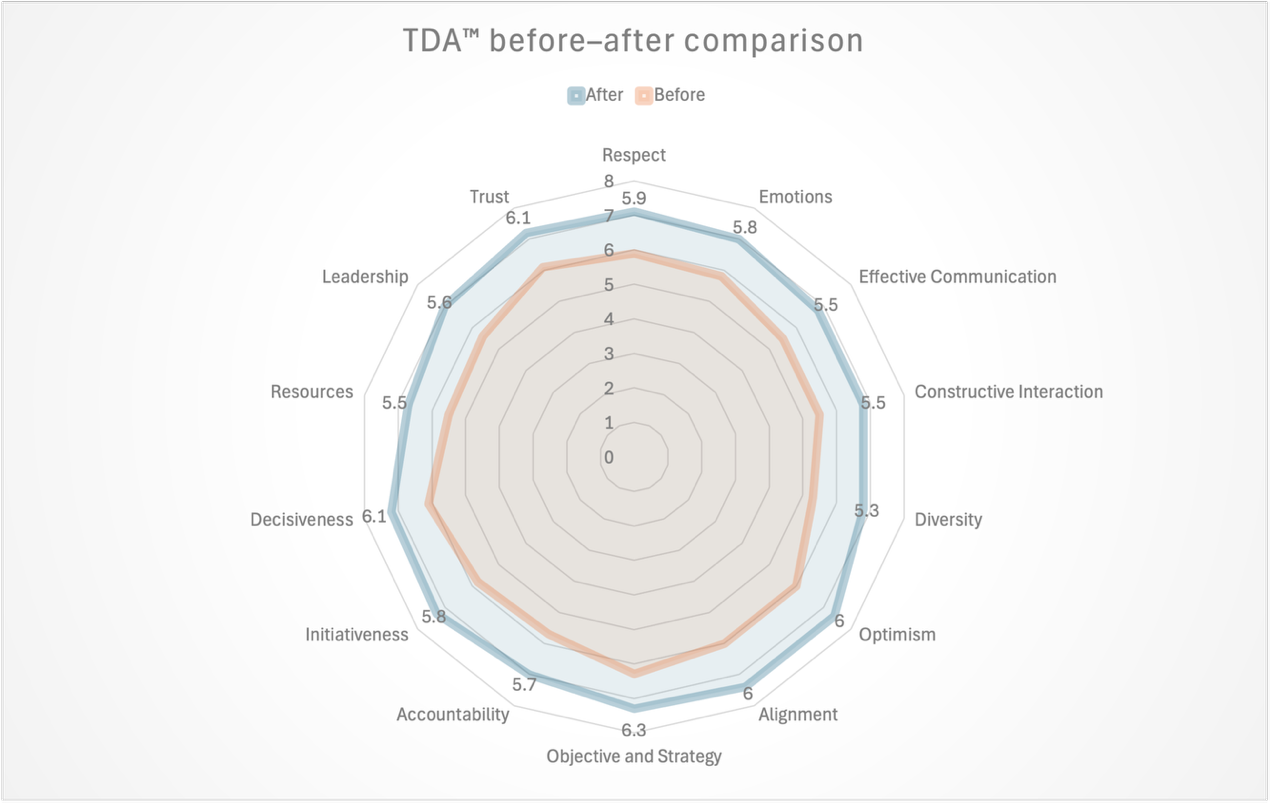
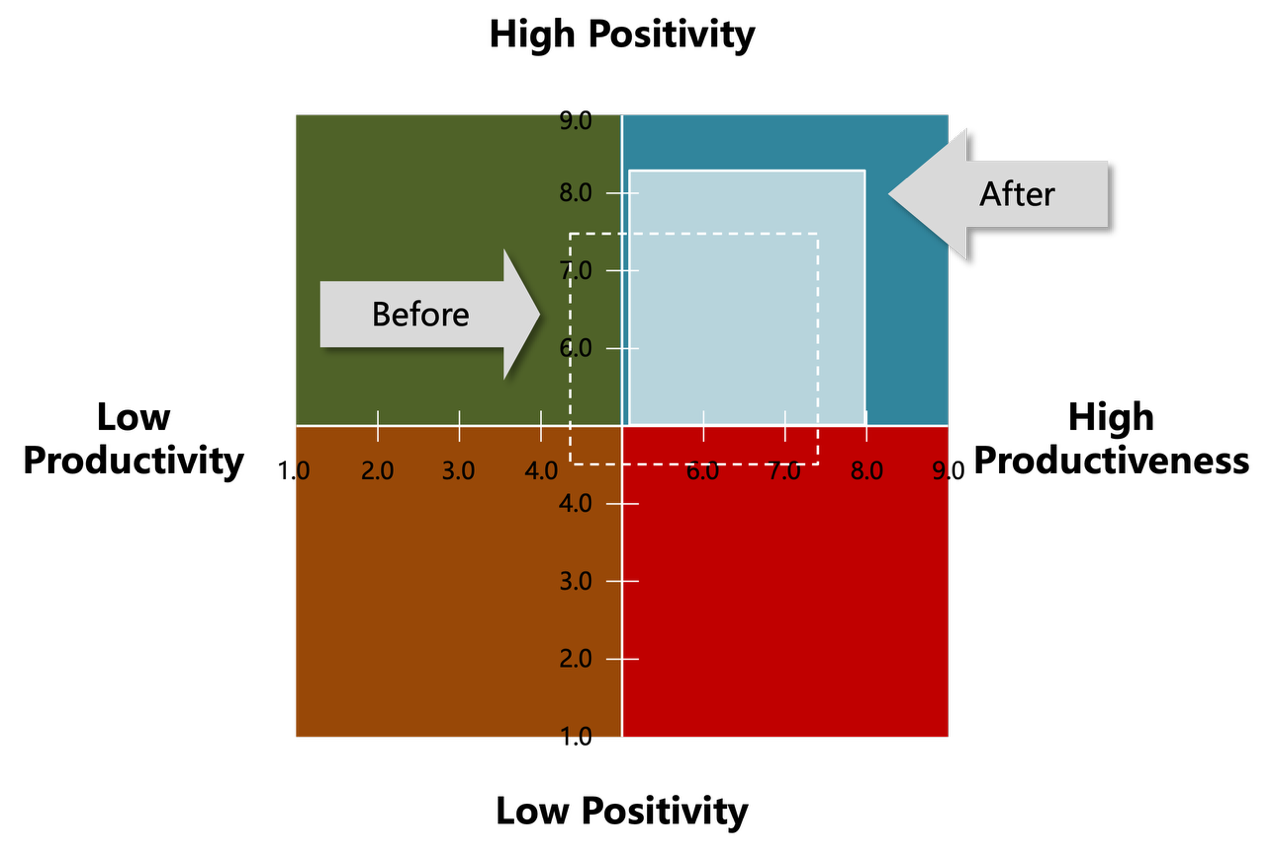
Behavioral outcomes (TDA™ before–after comparison)
- Constructive interaction: +25%
- Positive change: +32%
- Alignment: +27%
- Value diversity: +27%
- Productivity: +25%
- Positivity: +20%
Business outcomes
- Whole‑vehicle sales up 3x
- Sales revenue up 6x
- Team energy and morale significantly higher, with employees reporting a clear uplift in “spirit and vitality”
Our Perspective: Team Coaching as a Key Tool in Integration
This case shows that during restructuring, integration or major transformation, team coaching is an efficient, systemic and measurable organizational development tool. Recommendations for similar contexts include:
Involve team coaching early, when tensions first emerge and the window for intervention is strongest.
Use assessment data to target bottlenecks and design precise coaching strategies.
Balance behavioral change with business results, using business metrics as ultimate proof of impact.
Focus coaching on “real issues” that are tightly linked to the organization’s actual development priorities.
Copyright reserved by Talent Insight. Data and the example case mentioned in this article are provided by Talent Insight’s coaching team. Please state the source when forwarding.