
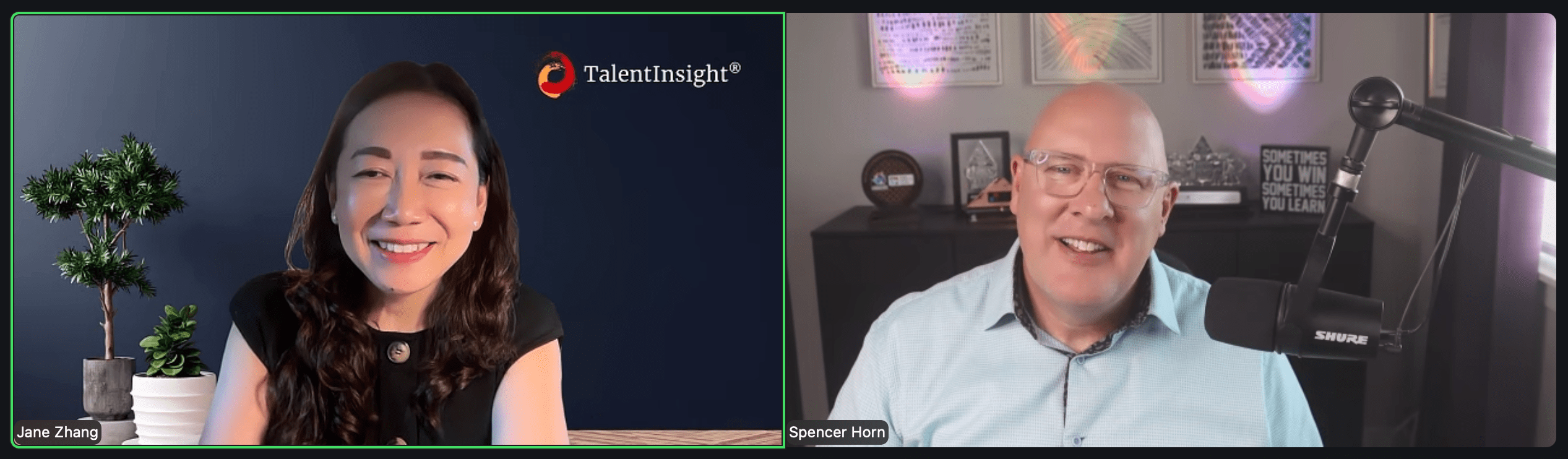
Watch the full webinar recording here: https://youtu.be/NDO-ZzjoUWU
Many organizations invest heavily in developing better leaders. They provide executive coaching, leadership training, and management development programs, expecting stronger leadership to naturally produce stronger teams.
Yet many organizations encounter the same frustration:
The leader improves—but the team doesn’t.
Communication remains fragmented. Accountability is inconsistent. Cross-functional collaboration stalls. Old patterns quickly reappear after workshops and offsites.
This was the central question explored in our recent webinar with Spencer Horn, President of Team Coaching International (TCI), and Jane Zhang, Founder of Talent Insight and TCI’s Strategic Partner across Europe and Asia.
The discussion reinforced an important truth:
If we want lasting organizational change, we cannot coach only the individuals within a team—we must coach the team as a living system.
Most organizations have talented people.
Many have capable leaders.
Yet truly high-performing teams remain surprisingly uncommon.
During the webinar, Spencer shared research from Team Coaching International alongside studies from McKinsey, Harvard Business Review, and Qualtrics, all pointing to a similar conclusion: only a small percentage of teams consistently achieve both outstanding performance and healthy collaboration.
This raises an important question.
If organizations continue investing in leadership development, why do so many teams continue struggling?
The answer is that organizations often try to solve a collective challenge with individual solutions.
One of the core principles behind Team Coaching International’s methodology is simple—but transformative:
A team is a living system.
Every team develops invisible patterns over time.
These include:
– unwritten rules about communication
– assumptions about decision-making
– habits around accountability
– acceptable and unacceptable behaviors
– patterns of trust—or distrust
– ways conflict is avoided or addressed
None of these appear on an organizational chart.
Yet they shape almost every interaction.
Changing one individual—even the leader—does not automatically change these system dynamics.
The system often pulls everyone back toward familiar behaviors.
That is why many leadership interventions create enthusiasm in the short term but fail to produce sustainable change.
Traditional executive coaching remains incredibly valuable.
Helping leaders improve their self-awareness, communication, and decision-making creates meaningful individual growth.
But team coaching asks a different question.
Instead of asking:
How can this leader become more effective?
it asks:
How does this team function together?
The team itself becomes the client.
Rather than focusing on individual behavior alone, the coaching explores collective patterns:
– How are decisions really made?
– Where does accountability break down?
– Which conversations never happen?
– What assumptions are limiting performance?
– What enables trust—and what quietly erodes it?
These are systemic questions.
And systemic questions require systemic interventions.
One of the highlights of the webinar was introducing TCI’s well-established Productivity + Positivity framework.
Great teams require both.
Productivity
High-performing teams need the ability to execute.
This includes:
– clear goals
– alignment
– accountability
– effective decision-making
– proactive execution
– leadership
– resource management
Positivity
At the same time, sustainable performance depends upon the quality of relationships.
This includes:
– trust
– constructive interaction
– respect
– communication
– camaraderie
– optimism
– valuing different perspectives
Organizations sometimes assume these are “soft” factors.
In reality, they are the conditions that allow difficult conversations, innovation, collaboration, and accountability to happen consistently.
Performance without trust often creates burnout.
Trust without accountability often creates complacency.
The strongest teams intentionally develop both.
An idea that resonated strongly with participants was TCI’s four team climates.
Teams naturally move between combinations of high or low Productivity and Positivity.
Some teams achieve exceptional collaboration and exceptional execution.
Others are friendly but avoid difficult conversations.
Some deliver impressive short-term results while operating under constant stress and burnout.
Others struggle with both performance and relationships.
Recognizing a team’s current climate allows coaches and leaders to move beyond assumptions and begin working with real data rather than opinions.
One of the biggest challenges in organizational development is that team dynamics are often invisible to the people experiencing them.
Everyone sees part of the picture.
No one sees the whole system.
This is why Team Coaching International developed the Team Diagnostic™.
Rather than relying solely on observation or interviews, the diagnostic captures anonymous feedback from every team member, allowing the team to view its collective patterns objectively.
When the results are shared, something important happens.
The conversation changes.
It is no longer:
“My opinion versus yours.“
Instead, the team begins exploring:
“What are we learning about ourselves?“
That shift creates the foundation for meaningful dialogue—and ultimately, meaningful change.
During the webinar, Jane Zhang shared one of Talent Insight’s own client engagements with the leadership team of DSM Engineering Plastics China.
The organization was navigating multiple simultaneous pressures:
– market decline
– organizational restructuring
– continuous business adjustments
– internal competition
– siloed functions
– declining morale
Rather than focusing only on individual leadership development, the engagement centered on the team as a system.
The results were measurable.
The Team Diagnostic™ showed improvements including:
– Accountability +29%
– Alignment +19%
– Constructive Interaction +19%
– Trust +11%
Overall, the team achieved a 16% increase in Productivity and a 15% increase in Positivity.
Even more importantly, these changes translated into business outcomes.
Customer complaint handling time was reduced by 71%.
Delivery performance improved by 71%.
Employee engagement increased significantly, and the leadership team later received global recognition within the organization for its transformation.
This illustrates an important point.
Effective team coaching is not simply about helping people feel better together.
It is about enabling teams to perform better together.
Organizations today operate in an environment that is increasingly complex.
Global collaboration.
Cross-functional work.
Matrix structures.
Hybrid teams.
Constant transformation.
These challenges cannot be solved through technical expertise alone.
They require teams that learn continuously, adapt together, and develop the capability to navigate uncertainty collectively.
The ability to coach teams—not just individuals—is becoming an increasingly important capability for leaders, coaches, HR professionals, and organizational development practitioners alike.
We were delighted by the thoughtful participation throughout the webinar—from the live polls to the rich questions shared in the discussion.
It confirmed something we continue to see across industries and countries:
Organizations are looking for approaches that move beyond one-off workshops and create sustainable, measurable change.
At Talent Insight, we remain committed to helping organizations build stronger leadership teams through evidence-based team coaching, executive coaching, leadership development, and organizational transformation.
As Jane Zhang shared during the session:
“When teams can see themselves clearly, they can choose to work differently.”
That awareness is often the beginning of lasting transformation.
If you were unable to join the webinar and would like to receive the recording—or learn more about Team Coaching International’s CTPC Team Coaching MasterClass and the Team Diagnostic™—we would be delighted to connect with you.
Talent Insight partners with organizations across Europe and Asia to develop leaders, strengthen teams, and build organizations capable of thriving in an increasingly complex world. Through executive coaching, team coaching, leadership development, and organizational consulting, we help clients turn insight into sustainable business results.
Copyright 2026 @Talent Insight. All Rights Reserved